
Soundings
Our Perspectives and Insights
Never Get Good at Diving Catches, Even with AI
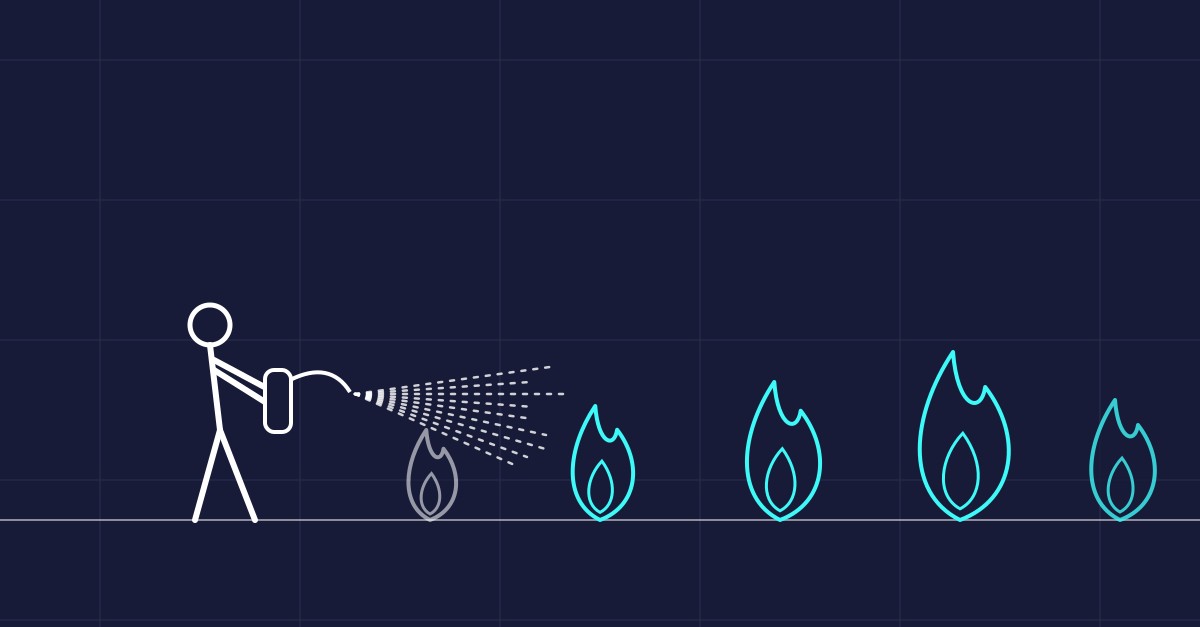
Why the asset every buyer is really paying for is predictable results, and why you still have to move fast to get them.
I’ve said this to more teams than I can count, across more companies and positions than I’d care to admit: no company should ever get good at making diving catches.
A diving catch is the save. The deal rescued at midnight, the client fire put out by the one person who knows where everything lives, the month that closes only because someone heroic made it close. Every team needs one now and then. The trouble starts when a team gets good at them, because a team that’s good at diving catches is a team that keeps needing them.
That matters most at the moment someone tries to put a price on the business. If you’re selling a company, or buying one, the asset underneath every multiple is the same: results you can predict. A buyer isn’t paying for last year’s number. They’re paying for confidence in next year’s.
Now enter AI.
Predictable Doesn't Mean Slow
The easy misread is that predictable means standing still. With AI especially, a company has to move fast: try new things, change how the work gets done, and take advantage of what shows up before a competitor does. All of that is irregular by nature. The new pilot, the unplanned client request, the process somebody improvised on a Tuesday afternoon.
Speed creates the irregular. Predictability is what you build out of it. The companies that manage both have a process that takes what’s new or irregular and refines it into something regular, every time.
Peter Drucker made the point long before AI: a well-run factory is boring, because its crises were seen coming and turned into routine.
I’d push it one step further. Boring is the goal. The way you get there is continuous improvement. No factory got boring by avoiding new things. It got boring by turning every surprise it lived through into routine, one at a time.
What Has to Be in Place for Predictable Results?
Without AI, the answer is well known. A result has to be recorded, which means the books close on time, the same way, every month. The record has to be accurate, which works back to time entries and engagements closed out on time. The work behind it has to be repeatable, a process that doesn’t depend on a hero. And there has to be continuous improvement: every diving catch gets handled, processed and folded back into the process so it isn’t needed again. That’s the standard playbook, and most good operators already run some version of it.
AI breaks that playbook in three places, and each one maps to a step most companies think they already have covered.
A team that’s good at diving catches is a team that keeps needing them.
- The answers aren’t deterministic. Ask the same question twice and you can get two different answers, and AI’s edges are jagged: excellent on one task, wrong on the one right next to it. A result built on AI output can be recorded perfectly and still not be the same result next time, so accuracy now needs a tolerance someone has agreed to and a sample someone actually checks. If nobody has decided how much variation is acceptable, the record is just a snapshot.
- It can stop repeating without warning. Even when you’ve tested a piece of AI work and it holds steady, things outside your team can change it. The model gets upgraded, a vendor changes a default, a tool or a permission gets swapped, or someone edits the instructions. Nobody touched the work, and the output shifts anyway. A process that ran clean last quarter can drift this quarter, so every one of those swaps has to be treated as a change: tested and verified before anyone trusts the number again.
- It will escape continuous improvement. AI’s diving catches happen inside one person’s chat window. Somebody gets a client answer out the door at 11 p.m. with help from AI, the save works, and nothing about it ever reaches the process. The misses stay private too. If a catch doesn’t make it back into continuous improvement to change the process, it will repeat. Someone has to own bringing AI’s catches and misses back to the table.
That’s no reason to slow down on AI. If anything, continuous improvement matters more with AI than without it. The faster you move, the more irregular work you create, and the more of it has to be folded back in before it can show up in a number a buyer will trust.
The Small-Group Problem
Small groups are volatile by nature. When a handful of people carry the work, results swing with their calendars and their attention. One person out for two weeks and the quarter looks different.
AI makes a small group more productive. It doesn’t give them more attention. This happens as AI scales the output: the work multiplies, and review capacity stays exactly where it was. A small team using AI can produce far more than it can check, and the gap between the two is where the unpredictability lives.
AI’s diving catches happen inside one person’s chat window.
The founder is the sharpest version of it. In a founder-led company, the founder is often the best salesperson, the escalation point and the person making most of the diving catches. Give that founder AI and they can make more catches, faster, than ever before. That’s exactly the habit you don’t want to get good at, and it’s exactly what a buyer will discount.
The Bottom Line
Move fast with AI. Try the new thing. Make the diving catch when you have to. Then feed it back into continuous improvement, AI’s catches and misses included, so nobody has to make that same catch again.
A buyer will pay for AI that shows up in a predictable number. They’ll discount AI that only shows up as heroics. Never get good at diving catches, especially the ones AI makes easy.
A Pilot & Rutter principle.